

What is the flow rate through a Threaded 90 Degree Elbow?
Jan 15, 2026
When it comes to fluid systems, understanding the flow rate through various components is crucial for efficient and effective operation. One such component that plays a significant role in altering the flow direction is the Threaded 90 Degree Elbow. As a trusted supplier of Threaded 90 Degree Elbows, I am here to delve into the intricacies of flow rate through these essential fittings.
Understanding the Basics of Flow Rate
Flow rate refers to the volume of fluid that passes through a given cross - sectional area per unit of time. It is typically measured in units such as liters per second (L/s), cubic meters per hour (m³/h), or gallons per minute (GPM). The flow rate through a Threaded 90 Degree Elbow is influenced by several factors, including the properties of the fluid, the size of the elbow, and the pressure within the system.
Fluid Properties
The properties of the fluid, such as its viscosity and density, have a direct impact on the flow rate. Viscosity is a measure of a fluid's resistance to flow. High - viscosity fluids, like honey, flow more slowly than low - viscosity fluids, such as water. Density, on the other hand, affects the mass of the fluid passing through the elbow. Heavier fluids may require more energy to move through the system, which can impact the flow rate.
Elbow Size
The size of the Threaded 90 Degree Elbow is another critical factor. Larger elbows generally allow for a higher flow rate because they have a larger cross - sectional area. However, the relationship between size and flow rate is not always linear. As the size of the elbow increases, the frictional losses within the elbow may also increase, which can offset some of the benefits of the larger area.
System Pressure
The pressure within the fluid system is the driving force behind the flow. Higher pressures can push more fluid through the elbow in a given time, increasing the flow rate. However, excessive pressure can also lead to issues such as leaks or damage to the elbow and other components of the system.
Calculating the Flow Rate through a Threaded 90 Degree Elbow
Calculating the exact flow rate through a Threaded 90 Degree Elbow can be a complex task. One common approach is to use the Darcy - Weisbach equation, which relates the head loss in a pipe or fitting to the flow rate. The head loss in a 90 - degree elbow is due to both friction and the change in flow direction.
The Darcy - Weisbach equation is given by:

[h_f = f\frac{L}{D}\frac{V^{2}}{2g}]
where (h_f) is the head loss, (f) is the friction factor, (L) is the equivalent length of the elbow (a value that accounts for the additional resistance caused by the elbow compared to a straight pipe), (D) is the diameter of the elbow, (V) is the average velocity of the fluid, and (g) is the acceleration due to gravity.
To find the flow rate (Q), we can use the relationship (Q = A\times V), where (A) is the cross - sectional area of the elbow.
However, in practice, many engineers and technicians rely on empirical data and flow rate charts provided by manufacturers. These charts are based on extensive testing and can provide a more accurate estimate of the flow rate through a specific Threaded 90 Degree Elbow under different conditions.
Impact of Elbow Design on Flow Rate
The design of the Threaded 90 Degree Elbow can also have a significant impact on the flow rate. Elbows with a smooth interior surface reduce frictional losses and allow for a more efficient flow. Additionally, the radius of curvature of the elbow plays a role. Elbows with a larger radius of curvature generally have lower head losses and higher flow rates compared to elbows with a smaller radius.
Applications and Considerations
Threaded 90 Degree Elbows are used in a wide range of applications, from plumbing systems in residential buildings to industrial processes. In plumbing, they are used to change the direction of water flow around corners. In industrial settings, they may be used in chemical processing plants, oil refineries, and power generation facilities.
When selecting a Threaded 90 Degree Elbow for a specific application, it is essential to consider the flow rate requirements. Choosing an elbow that is too small may result in insufficient flow, while an elbow that is too large can be costly and may not provide any significant advantage in terms of flow rate.
Related Products
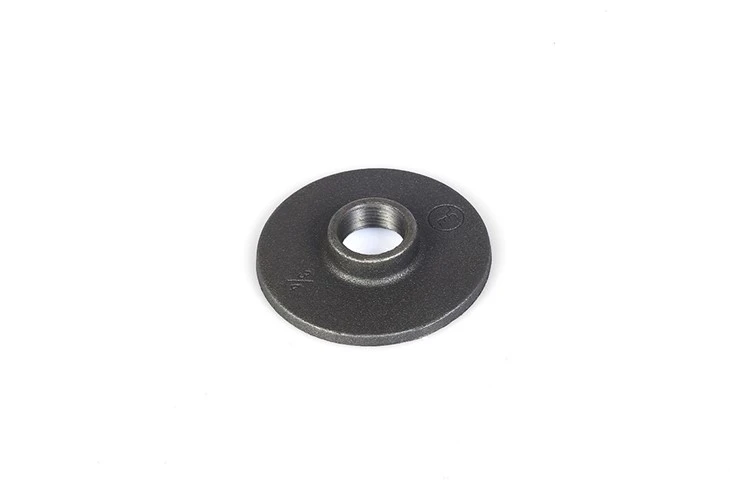
In addition to Threaded 90 Degree Elbows, we also offer a variety of other pipe fittings that can complement your fluid system. For example, our Malleable Iron Reducing Tee Pipe Fitting is ideal for applications where you need to combine or split the flow of fluid. Our Black Structural Pipe Fitting Floor Flanges provide a stable and secure connection for pipes in floor - mounted applications. And our Black Plumbing Fittings are suitable for a wide range of plumbing projects.
Conclusion
Understanding the flow rate through a Threaded 90 Degree Elbow is essential for the proper design and operation of fluid systems. By considering factors such as fluid properties, elbow size, system pressure, and elbow design, you can ensure that your system operates efficiently and effectively.
If you are in the market for high - quality Threaded 90 Degree Elbows or other pipe fittings, we are here to help. Our team of experts can provide you with the technical support and guidance you need to select the right products for your application. Contact us today to start a discussion about your procurement needs and let us help you find the perfect solutions for your fluid system.
References
- Crane Co., "Flow of Fluids Through Valves, Fittings, and Pipe," Technical Paper No. 410.
- White, F. M., "Fluid Mechanics," McGraw - Hill Education.