

Does the size of a Black Iron Cross Fitting affect its flow capacity?
Jun 23, 2025
Hey there! I'm a supplier of Black Iron Cross Fittings, and I often get asked a really interesting question: Does the size of a Black Iron Cross Fitting affect its flow capacity? Well, let's dive right into this topic and find out.
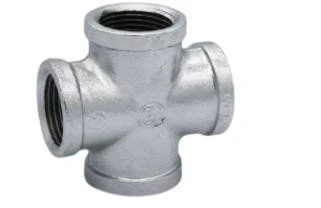
First off, what exactly is a Black Iron Cross Fitting? It's a crucial component in plumbing and piping systems. These fittings are used to connect four pipes at right angles, allowing the flow of liquids or gases in multiple directions. They're made of black iron, which is known for its durability and resistance to corrosion. You can check out our Malleable Iron Cross for a better idea of what I'm talking about.
Now, let's talk about flow capacity. Flow capacity refers to the amount of fluid that can pass through a fitting within a given time. It's measured in gallons per minute (GPM) or cubic meters per hour (m³/h). A lot of factors can influence the flow capacity of a fitting, and the size of the fitting is one of the most significant ones.
When it comes to the size of a Black Iron Cross Fitting, we're mainly talking about the diameter of the pipes it connects. Fittings come in various sizes, from small ones used in residential plumbing to large ones for industrial applications. Generally speaking, the larger the diameter of the fitting, the higher its flow capacity.
Why is that? Well, it's all about the cross - sectional area. The cross - sectional area of a pipe or fitting is the area of the circle formed by the inside of the pipe. The formula for the area of a circle is A = πr², where r is the radius of the circle. As the diameter of the fitting increases, so does the radius, and the cross - sectional area increases exponentially.
Let's take an example. Suppose we have two Black Iron Cross Fittings: one with a 1 - inch diameter and another with a 2 - inch diameter. The cross - sectional area of the 1 - inch fitting (with a radius of 0.5 inches) is A1 = π(0.5)² = 0.25π square inches. The cross - sectional area of the 2 - inch fitting (with a radius of 1 inch) is A2 = π(1)² = π square inches. The 2 - inch fitting has four times the cross - sectional area of the 1 - inch fitting. This means that, in theory, it can allow four times as much fluid to pass through it.
However, it's not as simple as just increasing the size to get more flow. There are other factors at play. For instance, the flow rate also depends on the velocity of the fluid. The velocity of the fluid is determined by the pressure difference across the fitting and the resistance to flow.
In a plumbing system, the pressure is usually provided by a pump or gravity. If the pressure is low, even a large - sized fitting may not be able to achieve its maximum flow capacity. The resistance to flow, on the other hand, is caused by friction between the fluid and the inner walls of the fitting. Fittings with a rougher inner surface will have more friction and thus lower flow capacity.
Another factor to consider is the design of the fitting. A well - designed Black Iron Cross Fitting will have smooth transitions and bends to minimize turbulence. Turbulence can cause energy losses and reduce the flow capacity. Our 4 Way Pipe Fitting Equal Cross Fig.180 is designed with these principles in mind to ensure optimal flow.
In addition, the type of fluid being transported also matters. Different fluids have different viscosities. Viscosity is a measure of a fluid's resistance to flow. For example, water has a relatively low viscosity, while oil has a higher viscosity. A fitting that can handle a high flow of water may not be able to handle the same flow of oil.
Now, let's talk about the practical implications of all this. In a residential plumbing system, the flow capacity requirements are usually not very high. A small - sized Black Iron Cross Fitting, like a 1/2 - inch or 3/4 - inch fitting, is usually sufficient for most applications. These fittings can handle the water flow for sinks, toilets, and showers.
In an industrial setting, however, the demand for flow capacity is much higher. Large - sized fittings, such as those with 4 - inch, 6 - inch, or even larger diameters, are often used. Industries like manufacturing, oil and gas, and chemical processing require high - volume fluid transfer, and they need fittings that can handle it.
It's also important to note that the size of the fitting should be compatible with the rest of the plumbing system. If you install a large - sized fitting in a system designed for smaller pipes, it may not work properly. The flow may be restricted at the connection points, and there could be pressure imbalances in the system.
We also need to consider the cost. Larger fittings are generally more expensive than smaller ones. They require more material to manufacture, and they may be heavier and more difficult to install. So, when choosing a Black Iron Cross Fitting, you need to balance the need for flow capacity with the cost.
When it comes to specific applications, different industries have different requirements. In the water treatment industry, for example, high - flow fittings are needed to ensure the efficient movement of water through the treatment process. Our Schedule 40 Long Radius Sweeps can be used in conjunction with Black Iron Cross Fittings to optimize the flow in these systems.
In the HVAC (Heating, Ventilation, and Air Conditioning) industry, the flow capacity of fittings is crucial for maintaining the proper temperature and air quality in buildings. The right - sized fittings can ensure that the refrigerant or air is circulated efficiently.
In conclusion, the size of a Black Iron Cross Fitting does have a significant impact on its flow capacity. Larger fittings generally have higher flow capacities, but other factors such as pressure, fluid viscosity, and fitting design also play important roles.
If you're in the market for Black Iron Cross Fittings and need to determine the right size for your application, I'm here to help. Whether you're working on a small residential project or a large industrial one, we have a wide range of fittings to meet your needs. Feel free to reach out to discuss your requirements and start a procurement negotiation. I'm confident we can find the perfect solution for you.
References

- "Fluid Mechanics" by Frank M. White
- "Piping Handbook" by Cameron Engineering and Associates